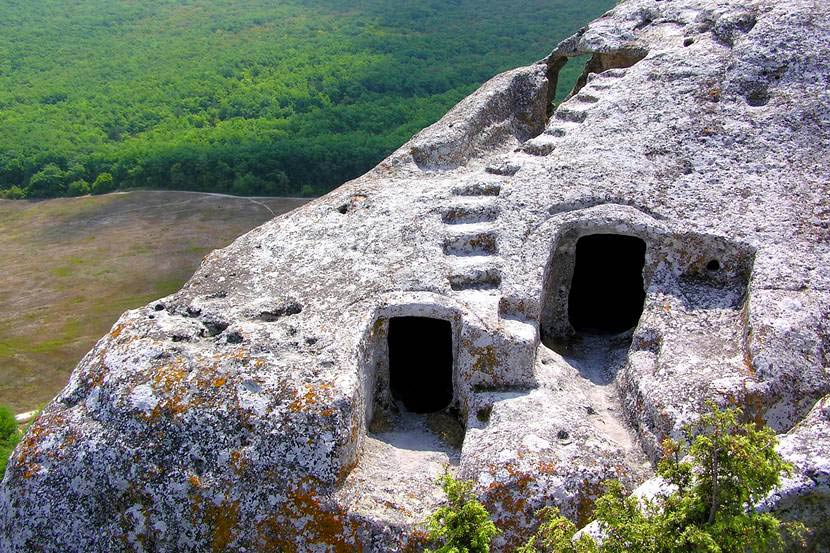
Eski-Kermen: the mystical pedestal of freedom
According to the official history, the city was built by the Goths, and they defended it for a long time until it was captured by the Khazars in the 8th century. Then came liberation, trade, and further development of the plateau. In the 13th century, the Mongol hordes advanced from the east, and in 1299, the city was completely burned down by Khan Nogai.
In 1941, the fascist whirlwind came from the west, and three years of occupation began.
A young Luftwaffe pilot flying over the “City of the Goths” (Eski-Kermen) was shot down and injured. He was found by a Crimean Tatar family who, over several months, nursed him back to health by applying animal fat to his wounds and wrapping him in felt. The pilot returned to his homeland, condemned fascism, and began engaging in modern art and performative practices. His works often involved felt and animal fat, through which he reflected on his traumas. The artist’s name was Joseph Beuys, and he later shared his Crimean story with journalists(1).
The photos of Eski-Kermen, taken by German pilots, are still used by scientists to visualize the plateau because, at that time, there was almost no vegetation, and they clearly show the destroyed city from above.
2010 year. Already on the approach to the cave city, you feel a rush of energy and anticipation of the unknown. The leading road and the main entrance to the town is a portal to the fabulous Seredsteppe or Seredhirya.
Another reality appears before your eyes: the entire cave city, shaped and sized like a spaceship from Lucas and Kubrick blockbusters with rounded compartments for various purposes: rest, eating, social gatherings, etc. Most of the caves resemble small, cozy houses where intelligent beings, a little smaller than our average height, could live comfortably. The portholes in compartments of completely different sizes: from the standard ship-sized to the diameter that fills the entire wall. And there are many holes of unknown purpose in the floor and ceiling. And the first story is related to this.
One late night, our group entered the cave with lanterns, set up our sleeping bags, and I walked alongside the wall to my friend for a bottle of water. In the morning, when I woke up, I saw that between me and my friend was a hole measuring one and a half by one and a half, and two meters deep. The previous evening, I was supposed to fall into it, but for some reason, it didn’t happen. Five people witnessed this situation, and we discussed it but couldn’t find a clear explanation.
I felt as if I had entered an abnormal zone. Here are some of my observations: Dasha, a slender girl who was with us in the group, started dancing in the afternoon. While in Spain, I was told about “Tener duende” – an inspiration, an emotional uplift, a state of trance that a dancer enters when performing flamenco. We applauded the girl, and later I asked: “What was that?” She replied that she had always wanted to dance but couldn’t find any time. Now, almost 14 years later, Dasha teaches dance classes in her city. My friend, the colonel, who is now fighting at the front, after coming from Eski-Kermen, bought brushes, canvases, paints and took up painting.
The longer I was on the plateau, the more my condition changed. I began to pay a lot of attention to the contemplation of nature: I could freeze for half an hour to watch the movement of ants, lay down in places where gravity came from the earth, and hug trees. I constantly felt filled with energy and the need to share it. Every summer, I felt drawn to the cave city, and I would go there, observing the behaviour of the new tourists who changed before my eyes.
Waking up on top of Eski to the rising sun between Chufut Kale and Mangup – what could be better?
But the dawn ended abruptly. The shadows converged in the east, and the year 2014 came. Occupation. The sky darkened over the entire peninsula.
The energy received in Eski-Kermen was looking for an outlet, and in 2017 I installed the sculpture “Solar Heart” (2), through which the sun passes at dawn, on the pier in Odessa. The sun of the cave city stayed with me and united the mountains and the sea.
When I was at the highest point of Eski-Kermen, which resembles the cockpit of a space liner, I was overwhelmed by the feeling of flight and freedom, which I embodied in the “Pedestal” (3) sculpture in Odesa in 2019.
Crimea is Ukraine, and Eski-Kermen is the mystical pedestal of our country’s freedom, and it is necessary to think about its restoration after deoccupation.
In the old town square, in front of the remains of the basilica, stone fragments were found from a stele that may have served as a sundial. I think that, after consulting with archaeologists, it should be restored or a new one should be created, where vertical layers will reflect the era of the existence of the cave city.
The development of international tourism is very important. I imagine that on the way to Eski-Kermen, there is a tourist route filled with modern land art (4), where a tourist makes a smooth transition from hectic life to the origins of antiquity.
The foothills of the cave city are located in a unique climatic zone, making it an ideal location for a sanatorium where Ukrainian military personnel could undergo rehabilitation. As I described above, it is necessary to take into account the creative energy of this place and create a residence on the plateau for sculptors, artists and people of other creative professions. Participants of the residency under the guidance of archaeologists will be able not only to pursue their creative plans but also to contribute to the restoration and rehabilitation of Eski-Kermen. All this can be created in a complex with the development of modern public art, art in public space, which is aimed at the unprepared viewer and leads to communication with the environment of the surrounding territory, given the historical and climatic uniqueness of the district (5).
I would like to quote a small excerpt from my articles written in 2022 about public art:
“During the war, our people suffered a huge physical and psychological trauma, which will be experienced for more than one decade. We will rebuild ruined by the bombs houses and restore all communications, but it is even more important to appeal to the soul of every Ukrainian. It will be very difficult for us to be in an environment filled with Soviet and imperial statues, knowing the consequences it led to. After WWI, the English sculptors Moore and Hepworth began to give a new face to the old aesthetic regime. They sought to generalize it through abstraction, which became one of the reasons for the appeal of this art and one of its ideological functions. Many sculptures by Moore, Calder and other masters became modern symbols of the cities. Public art began to influence the psychological state of people who survived the First and Second World Wars saw their cities in funnels and covered with anti-tank hedgehogs, and will not soon be able to say goodbye to these pictures. Now it is very important to turn our attention to works of art, which, according to Walter Benjamin, have a unique, inspiring “aura”. These can be murals and temporary installations, which, in the future, can be replaced by other monumental art objects.” (6)
Public art covers all areas where people pass through, and the presence of art objects on tourist routes raises the popularity of a place, improves the environment and has a positive psychological effect on viewers. The comprehensive revival of Eski-Kermen will set the stage for the creation of a large tourist cluster of all the cave cities of Crimea, with a developed infrastructure for health and cultural enrichment. An important aspect to consider for Crimea’s future prospects is to demonstrate its deep cultural connections over time, delve into the peninsula’s millennia-old history, and outline pathways for the comprehensive development of contemporary Ukrainian art. The organization of art residencies, the opening of museums of modern art, the organization of educational programs, plein airs, festivals, exhibitions and the development of public art will make it possible to increase interest in the culture of Crimea outside the country, get rid of the totalitarian past and open the way to sustainable democracy.
Andrii Liubov 2024.
Used sources:
- Йозеф Бойс — Вікіпедія
- Скульптура «Сонячне серце» – Арт-майстерня Bloom
- Арт-об’єкт «П’єдестал» – Арт-майстерня Bloom
- Лендарт — Вікіпедія
- Паблік-арт — Вікіпедія
- Паблік-Арт*: Відродження після війни. Частина 1
- Photo- https://culture.voicecrimea.com.ua/uk/horodyshche-artezian-na-storozhi-bosporskoho-tsarstva/