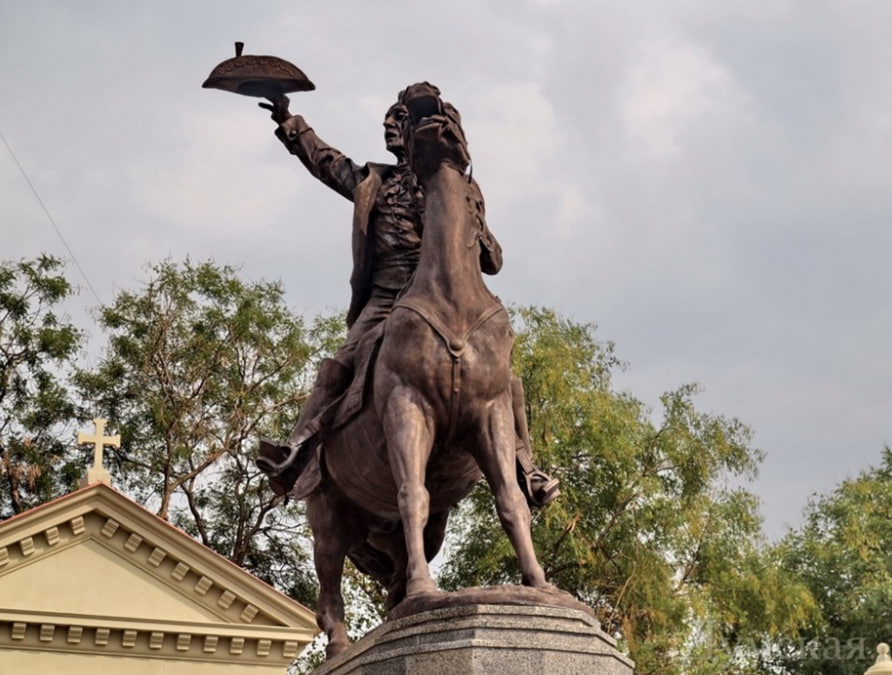
*Photo from the "Dumska" website. Odesa
“A monument is something that makes children ask their parents about the causes and significance of historical events.” — Martin Hladenius
*— A methodical guide from Russia, from Marat Gelman’s Telegram channel.
What can art on the streets of the city be like? It can be as diverse as possible, and the more, the better!
What can art on the streets of the city be like after the war? It should be diverse but not the kind that inspired the aggressor or was used in propaganda of hatred!
The images of Soviet military leaders and imperial “field marshals” need to be rethought in the light of building a peaceful future.
What happened to the monuments of Mussolini and Hitler? These dictators were primarily interested in architecture, and the most significant structures, like the Reich Chancellery building, were demolished. Nazi symbols were removed from other buildings and “recontextualized” by placing anti-fascist quotes or repurposing the structures.
“The black-and-white choice came down to either removing the monuments or preserving them as they were. Demolishing them would mean destroying material evidence of history and avoiding difficult conversations; keeping them would mean accepting fascist rhetoric as a permissible norm,” says Hannes Obermeier, professor of modern history at Innsbruck University.
Ukraine has faced this problem since the annexation of Crimea, and after Russia’s invasion, the issue cannot be postponed any longer. The ongoing decommunization process removed banal ideological monuments from cities before the war, but there are still works whose fate must be decided collectively with all citizens. European countries that faced dictatorships found different solutions: for example, the “Pact of Forgetting” in Spain prohibited the use of Francoist monuments for official events. A later law, the “Law of Historical Memory,” required municipalities to destroy monuments and plaques dedicated to the dictator and regime figures.
In Odesa, a sculptural copy of Suvorov was installed in 2012 (the original is in the city center of Izmail). This military leader is connected to the city’s history, and many have heard of his successful campaigns, but few question the purpose of, for example, his army’s crossing of the Alps and other military operations. Besides the statue, an entire district in Odesa bears his name. Another district is named after a Soviet marshal (Malinovsky), and streets and squares named after commanders (Chernyakhovsky, Tolbukhin) who followed Stalin’s orders remain. The same situation is present in many cities across our country. Is this justified in today’s world and modern Ukraine?
To address these issues, officials, historians, and cultural figures need to be involved, roundtable discussions should be held, and based on the historical moment, a course should be set for what has the right to remain in the nation’s memory and to define the direction of the country’s future development.
Public Art — art in an urban environment, aimed at an unprepared audience and intended to communicate with the urban space (Wikipedia).
References:
Pact of Forgetting, Spain, 1977.
The Law of Historical Memory, Spain (Law 52/2007, December 26, 2007).
Potsdam Conference Decision, 1945.
A.I. Liubov, Art engineer, sculptor. Head of the creative association “Public Art” and the public organization “Art Workshop BLOOM.” Odesa.
November 9, 2022.