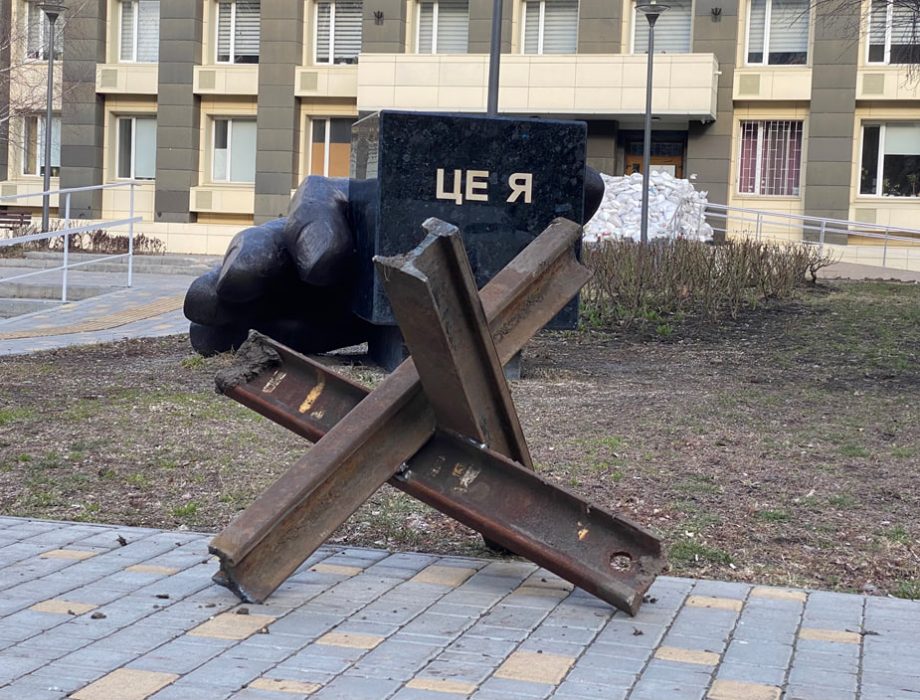
Sculpture “Pedestal” (IT’S ME). Odesa. Author: A. Liubov.
“Art does not exist without pain; at the same time, art exists to compensate for pain.” — Till Lindemann.
Many critical articles about works of art reference psychoanalysis as a way to understand the driving force behind the artist. Therefore, all art carries a therapeutic effect.
During the war, our people endured immense physical and psychological trauma that will be processed for many decades.
We will rebuild the bombed buildings and restore all communications, but it is even more important to address the soul of every Ukrainian. It will be very difficult for us to live in an urban environment filled with Soviet and imperial statues, knowing the consequences they led to.
And although we shouldn’t expect a huge surge of interest in visiting museums and galleries, street art in cities can already begin its therapeutic work. After WWI, English sculptors Moore and Hepworth began giving a new look to the old aesthetic regime through art objects. They sought not to destroy the figure but to generalize it through abstraction. This innovative approach became one of the reasons for the appeal of this art and one of its ideological functions.
Many sculptures by Moore, Calder, and other masters have become modern symbols of cities.
Public art began to affect the psychological state of people who had survived World War I and World War II. Children and adults who saw their cities filled with craters and tank barriers will not soon be able to part with those images. At this moment, it is crucial to shift attention to art objects, which, according to Walter Benjamin, have a unique, inspiring “aura.” These can be murals and temporary installations, which can later be replaced by other monumental art objects.
It is necessary to adopt the concept of each Ukrainian city as an “open-air museum,” where street exhibits can inspire residents and provide an opportunity for discussion in the realm of art.
Immediately after the end of the war, it would be desirable to hold a Public Art festival in every city. On the one hand, this would support artists and sculptors, and on the other, it would provide the opportunity to select temporary art objects for installation in streets and squares. Such festivals would visually enhance the cities and set a creative direction for the development of the Ukrainian people.
*Public Art – art in an urban environment, aimed at an unprepared audience and intended to communicate with urban space (Wikipedia).
References:
“Art Since 1900: Modernism, Antimodernism, Postmodernism”, Rosalind Krauss, Hal Foster, Yves-Alain Bois, Benjamin H. D. Buchloh, David Joselit, 2015
“Henry Moore: A View of Sculpture”, 1930
Walter Benjamin, “Das Kunstwerk im Zeitalter seiner technischen Reproduzierbarkeit” (The Work of Art in the Age of Its Technical Reproducibility), 1936
A. Liubov, Art engineer, sculptor. Head of the creative association “Public Art” and the public organization “Art Workshop “BLOOM” Odesa, 11/02/2022